
7 pricing/monetization experts we read to stay ahead of the competition

LinkedIn, Substack and every other platform is full of bad pricing and monetization advice:
“Outcome-based pricing is the future!”
“AI has killed subscriptions!”
“Users only want to pay for what they use”
Pricing and monetization advice has the same problem as all internet content: The more controversial your take, the more likes you get. The truth (“it depends”) doesn’t get engagement.
But that doesn’t mean you shouldn’t follow anyone’s advice. It just means you should exclusively follow Lago’s advice and buy our billing system listen to real experts who teach you first principles that let you derive the best monetization strategy for you.
In this newsletter, we want to highlight some of our favorite thinkers on pricing and monetization and their best advice:
1) Elena Verna: “Start with monetization, not price”
Elena Verna currently leads growth at Lovable and previously did so at Dropbox and Amplitude. She also writes Elena's Growth Scoop and is a LinkedIn top voice.
Many companies worry about how much to charge. When AI arrived, we suddenly had to think about how to charge again. The latter is much harder than the former. Get the number wrong and you’ll miss out on some revenue. Charge for the wrong thing and nobody will buy your product.
As Elena Verna told us. “Pricing is only an aspect of monetization.” Treat monetization as what you charge for, when, and why. That means optimizing value metrics, packaging, paywall timing, and building an internal org to run it.
Who should own pricing?
Finance traditionally owns pricing. But because pricing is no longer obvious, pricing needs more stakeholders: Finance doesn’t talk to customers, so they don’t know how they’d like to pay. Sales doesn’t work on the billing system, so they don’t know how long it takes to ship new pricing models.
To make sure all stakeholders contribute their expertise. Elena Verna advocates for a dedicated “Monetization Pod” which includes sales, growth, product and engineering.
2) Madhavan Ramanujam: AI has worse margins, but lets you capture more value
Madhavan Ramanujam is a General Partner at 49 Palms Ventures. He wrote the books Scaling Innovation and Monetizing Innovation.
In a recent episode of Lenny Rachitsky‘s podcast, Madhavan Ramanujam shared this simple framework for AI pricing:
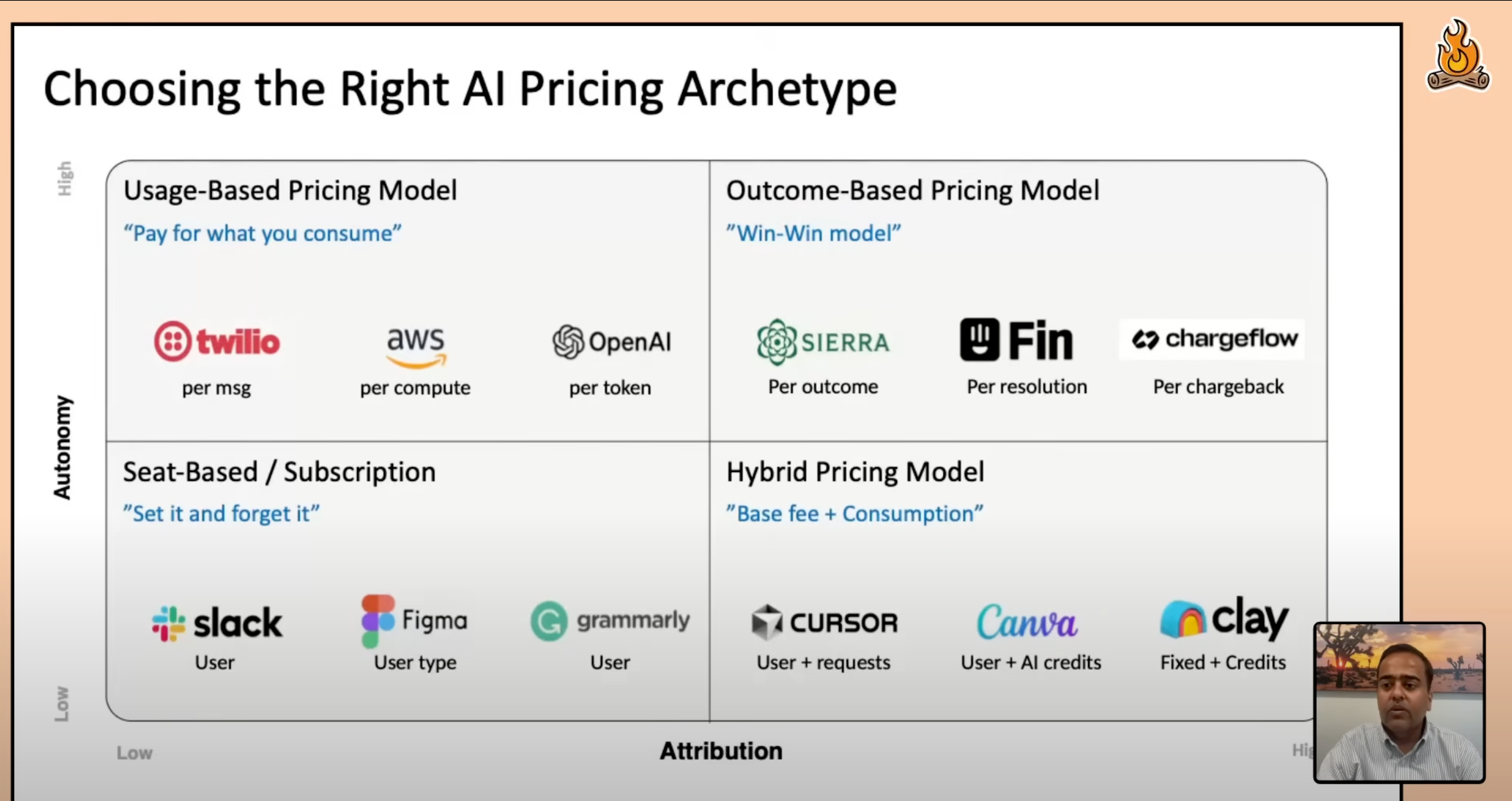
This framework simplifies choosing a pricing model and shows that all of them are still viable, but flow from your product category and usage patterns.
He also shared that AI may have worse gross margins (because each individual bit of usage has real costs), but better value capture: conventional SaaS captures 10-25% of value created while AI-powered products capture 25-50% of the value they create.
3) Kyle Poyar: Seat-based pricing is under threat
Kyle Poyar is the founder and creator of Kyle Poyar’s Growth Unhinged as well as a co-founder and operator at Tremont, an early-stage venture fund.
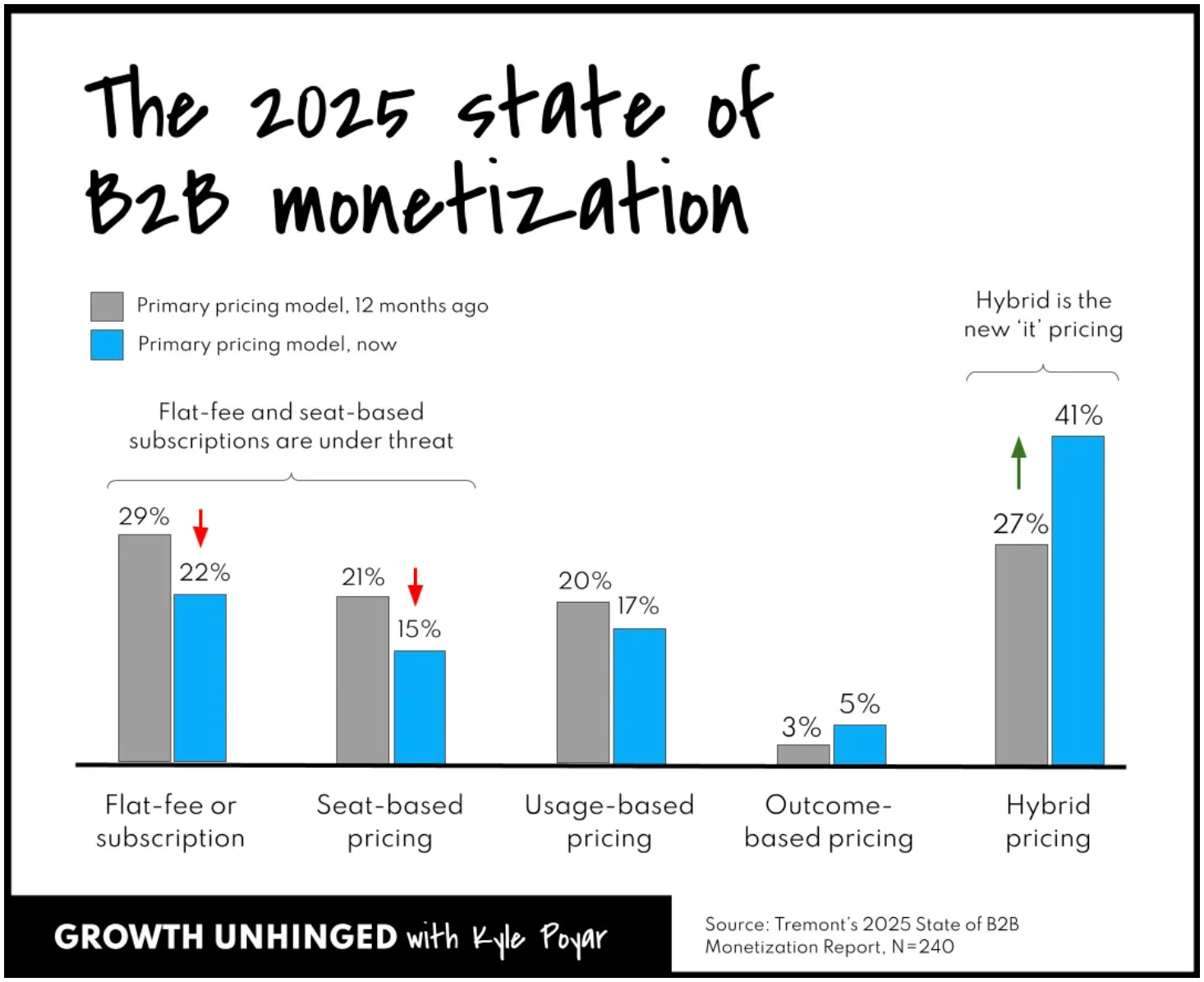
His 2025 stage of B2B monetization report shows a continuing decline of seat-based or flat-fee subscriptions. This is likely due to companies launching AI features/products and new startups being powered by AI.
Expensive AI usage then leads to an expansion in hybrid pricing (the decline in flat-fee pricing and seat-based pricing almost adds up perfectly to the increase in hybrid pricing. Hybrid pricing usually means subscriptions with overages, credit-based pricing or similar models that primarily charge a regular subscription, but have a usage-based component.
Outcome-based pricing is still nascent and likely has limited use cases, so a low percentage is logical.
4) GoodBetterBest: Credit-based pricing is here to stay
Rob Litterst and John Kotowski are the team behind Good Better Best, the most focused newsletter on pricing and monetization.
Their most recent post How to Use Credit Models dives deeply into the variety of credit models and why they’re so popular in AI.
Tl;DR: Credit pricing is here to stay and you should understand its complexities if you’re building with AI.
Most importantly: Be transparent with credit consumption. What action consumes how many credits? Are they topped up automatically? How much is a credit worth? What types of usage consumes credit? Which doesn’t? etc.
5) CJ Gustafson: Usage-based pricing grows companies way faster
CJ Gustafson is the writer of Mostly Metrics and hosts the Run the Numbers podcast. He was previously the CFO of PartsTech.
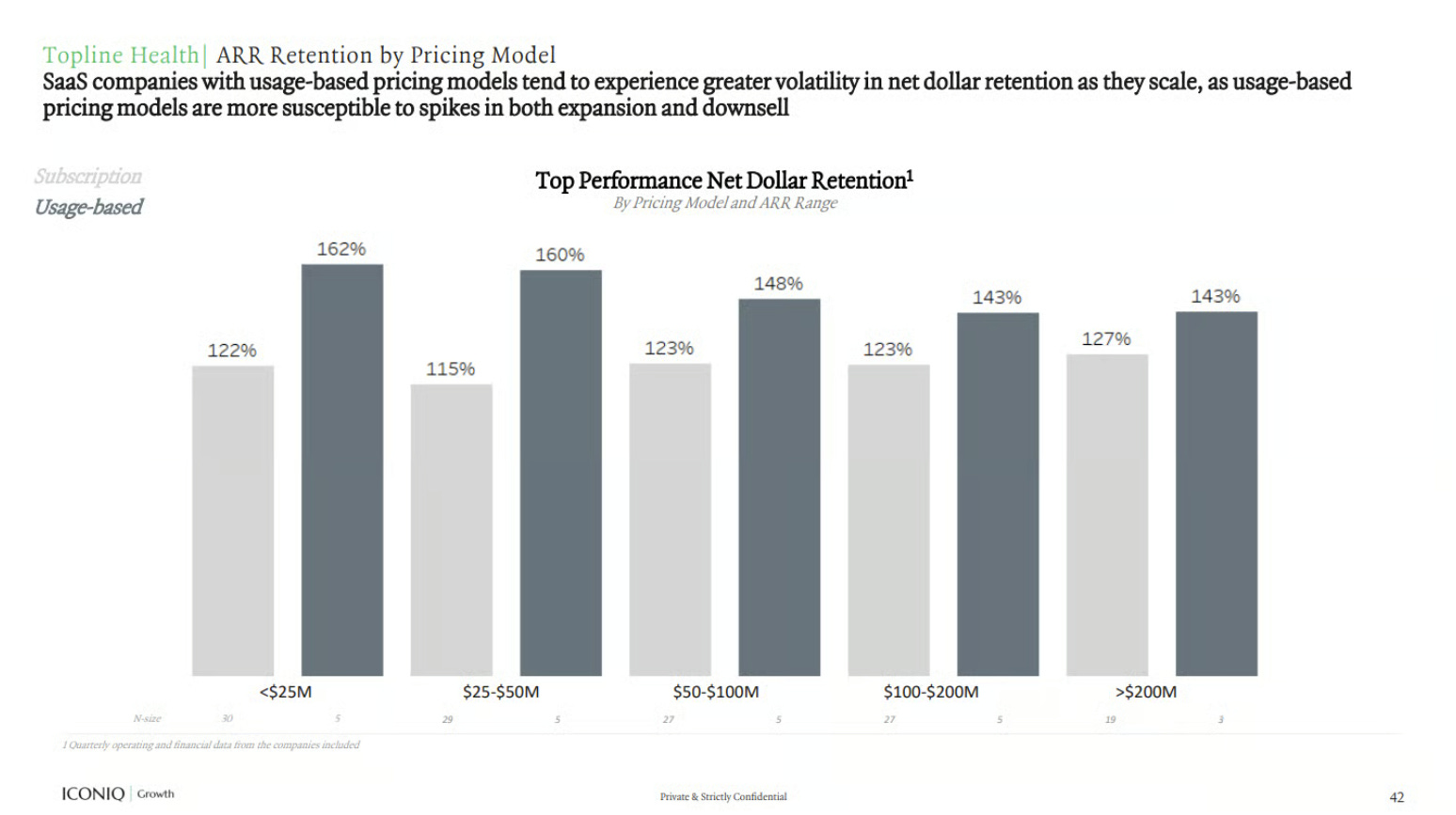
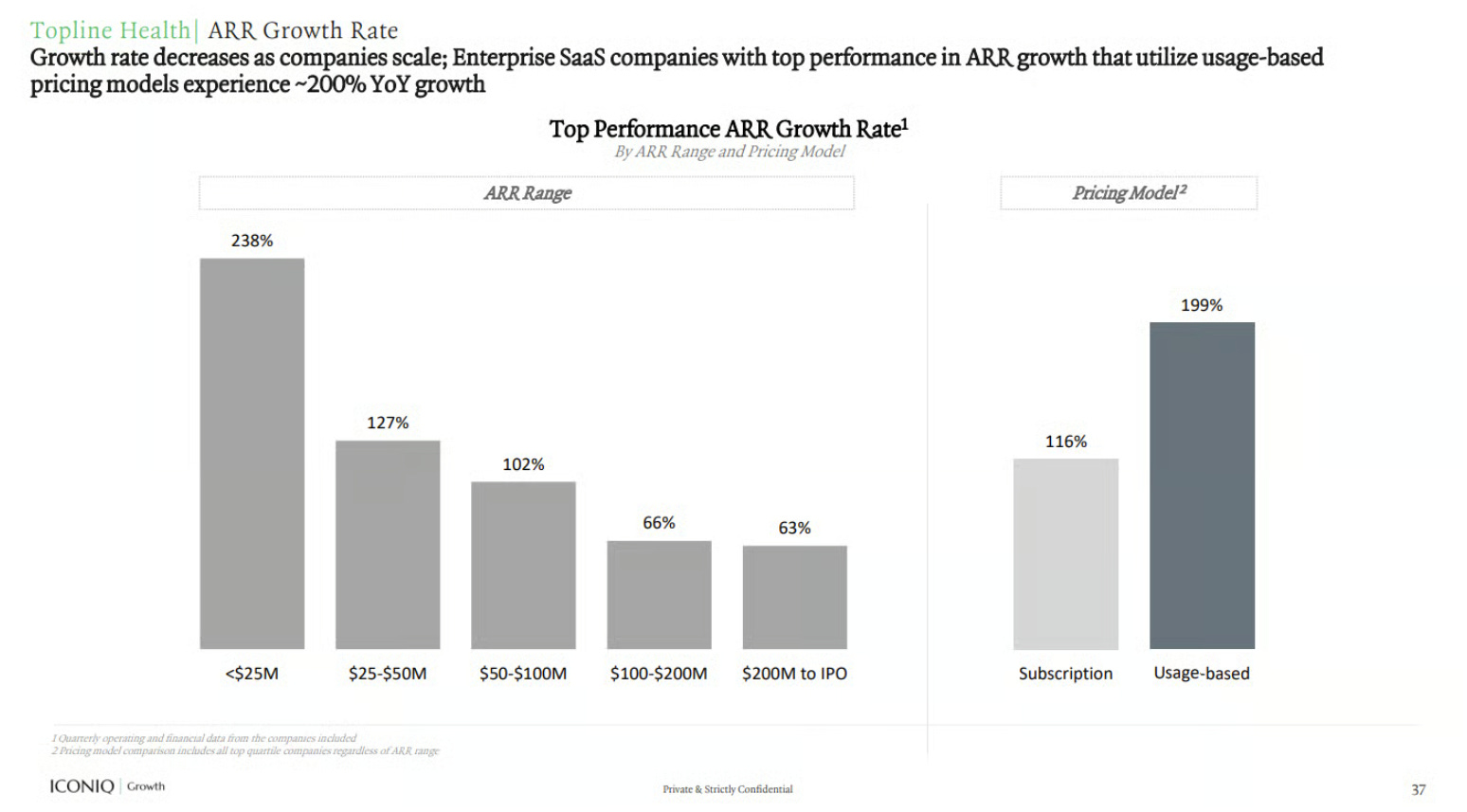
In A Primer: Subscription vs Usage Based Pricing Models, he highlights that usage-based pricing leads to both:
Higher NRR (customers stay around longer and spend more)
Higher ARR growth overall:
Does that mean every product charge for usage? No. Many categories don’t make sense for usage-based pricing (Pay Figma by the frame? No thank you!).
Instead of a strict improvement, it exacerbates outcomes. As CJ puts it:
It seems like usage based success is a self-fulfilling prophecy of sorts if you are already selling a superior product. But if you are selling something that’s just run of the mill, it makes you more susceptible to downturns; there’s a larger surface area for both success and failure. And if you suck, you’re going to REALLY suck with UBP.
6) OnlyCFO: Selling AI is hard. Buying AI is harder.
OnlyCFO is a pseudonymous CFO writing OnlyCFO's Newsletter.
Their recent post on the future of software pricing revealed that AI pricing is not only hard for the seller, but also for the buyer. As they point out:
I have purchased A LOT of software tools in my career - as both the primary buyer and as the finance leader giving final sign off. Here are the top pricing issues that have caused me to kill a deal (or at least push REALLY hard on it):
1. Weak correlation to value
I see this all the time now with AI features and some of the new pricing models. A company is told that one pricing model is superior for AI products so they implement it, but the correlation with value they their product is delivering is weak.
The pricing model must be strongly correlated to continuing value being delivered (new business and expansion).
2. Overly complex
I have seen many new AI features try too hard to be very scientific about pricing, but then it becomes too complex for anyone to understand (including the salespeople selling it).
If a salesperson can’t clearly articulate the pricing model and its value then it is too complex. It might even be the strongest correlation to value (#1 above), but if it is too complex to understand then that is bad too.
3. Hard to forecast
CFOs need to be able to accurately forecast costs. This was a major pro for seat-based pricing — forecasting was super easy.
Non-seat based pricing is almost always harder to forecast. You must provide tools and/or clear logic necessary for customers to forecast their spend. This is why overly complex (#2 above) pricing can be bad…if I can’t understand it then it will be hard for me to forecast.
CFOs have tight budgets to live by so they don’t want vendor spend that they can’t control/forecast screwing up their budgets.
4. Hidden costs
I am always on the hunt for the costs salespeople aren’t telling me about. Salespeople often get deals done but not being transparent here, but it always comes back to bite the vendor.
Customers will churn and talk poorly about your company’s pricing and cost of software.
AI pricing is harder. A seat-based subscription might be expensive, but rarely led to surprise bills or months-long procurement phases. Now, buying a new tool means long discussions, monitoring costs and modeling the usage you’ll pay for.
This is important to keep in mind when selling AI products, too.
7) The Bill, Please: The best deep dives and insights on pricing and monetization
The team at Lago is building the world’s best usage-based billing system (according to themselves).
Okay, just kidding, but if you’re still reading this, it looks like you’re enjoying our content. So why not subscribe?
If you’re not sure yet, here’s some of our best content: